
Ram Shalaka Prashnavali | Ramcharitmanas Prashnavali | Ram Prashnavali
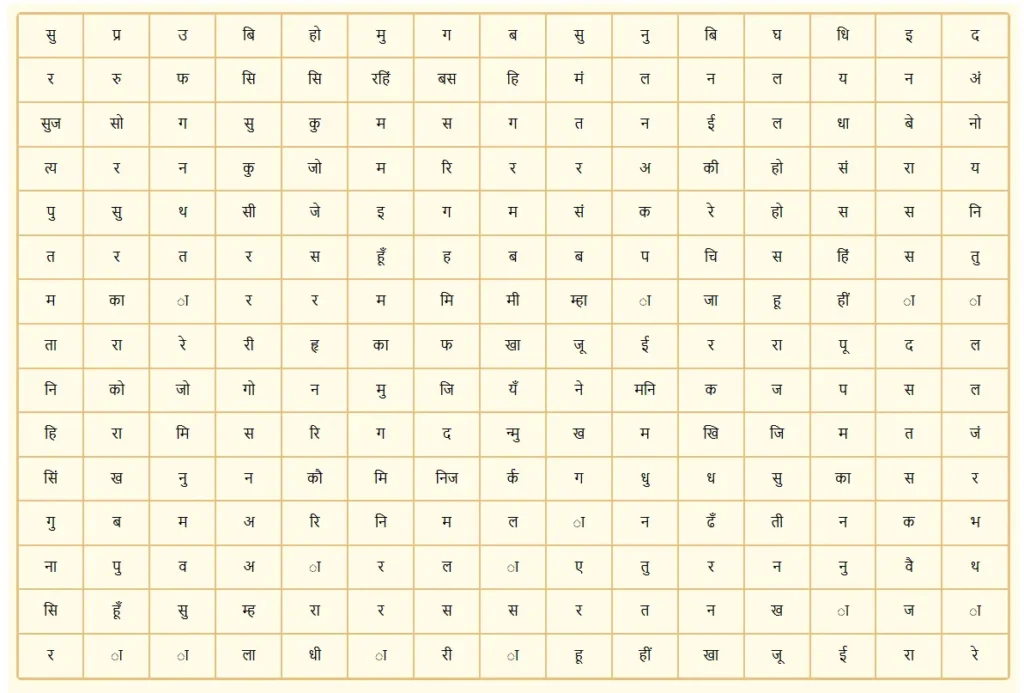
Say “Jay Shri Ram” and use this online Ram Shalaka Prashnavali which is an exact copy of original Ram Prashnavali from Ramcharitmanas book. To ask a question from Ramcharitmanas Prashnavali, first calm your mind and close your eyes and think of the question that you want to ask from Shri Ram. with closed eyes click anywhere on this Ramayan Prashnavali chart your answer chaupai table will load in a second.
| सु | प्र | उ | बि | हो | मु | ग | ब | सु | नु | बि | घ | धि | इ | द |
| र | रु | फ | सि | सि | रहिं | बस | हि | मं | ल | न | ल | य | न | अं |
| सुज | सो | ग | सु | कु | म | स | ग | त | न | ई | ल | धा | बे | नो |
| त्य | र | न | कु | जो | म | रि | र | र | अ | की | हो | सं | रा | य |
| पु | सु | थ | सी | जे | इ | ग | म | सं | क | रे | हो | स | स | नि |
| त | र | त | र | स | हूँ | ह | ब | ब | प | चि | स | हिं | स | तु |
| म | का | ा | र | र | म | मि | मी | म्हा | ा | जा | हू | हीं | ा | ा |
| ता | रा | रे | री | हृ | का | फ | खा | जू | ई | र | रा | पू | द | ल |
| नि | को | जो | गो | न | मु | जि | यँ | ने | मनि | क | ज | प | स | ल |
| हि | रा | मि | स | रि | ग | द | न्मु | ख | म | खि | जि | म | त | जं |
| सिं | ख | नु | न | कौ | मि | निज | र्क | ग | धु | ध | सु | का | स | र |
| गु | ब | म | अ | रि | नि | म | ल | ा | न | ढँ | ती | न | क | भ |
| ना | पु | व | अ | ा | र | ल | ा | ए | तु | र | न | नु | वै | थ |
| सि | हूँ | सु | म्ह | रा | र | स | स | र | त | न | ख | ा | ज | ा |
| र | ा | ा | ला | धी | ा | री | ा | हू | हीं | खा | जू | ई | रा | रे |
| Clicked Letter (चयनित अक्षर) | Sequence (अक्षर माला) |
|---|---|
| Click on any letter in the chart above to see the result. | |
| No. | Divine Guidance (परिणाम) |
|---|---|
| Your answer will appear here… | |
| 1 |
होइहै सोइ जो राम रचि राखा। को करि तर्क बढ़ावै साखा॥ “Hoihai Soi Jo Ram Rachi Rakha. Ko Kari Tark Badhavai Sakha.” Meaning: “Whatever Lord Ram has planned will happen. Why argue and increase doubt?”
Context / प्रसंग:
बालकाण्ड (शिव-पार्वती संवाद) Context: Bal Kand (Shiva-Parvati dialogue regarding Destiny).
Result / फल:
See Full Result in Detail →
अनिश्चित / ईश्वरीय इच्छा (UNCERTAIN / GOD’S WILL) Result: Stop worrying. Leave the result to God. |
| 2 |
सुनु सिय सत्य असीस हमारी। पूजिहि मन कामना तुम्हारी॥ “Sunu Siya Satya Aseesis Hamari. Pujihi Man Kamana Tumhari.” Meaning: “Listen, O Sita! My blessing is true. Your heart’s desire will be fulfilled.”
Context / प्रसंग:
बालकाण्ड (गौरी पूजन) Context: Bal Kand (Sita worshiping Goddess Gauri).
Result / फल:
See Full Result in Detail →
हाँ / पूर्ण सफलता (YES / SUCCESS) Result: Excellent. Your wish will be fulfilled immediately. |
| 3 |
प्रबिसि नगर कीजे सब काजा। हृदयँ राखि कोसलपुर राजा॥ “Prabisi Nagar Kije Sab Kaja. Hridaya Rakhi Kosalpur Raja.” Meaning: “Enter the city and complete all tasks, keeping Lord Ram in your heart.”
Context / प्रसंग:
सुंदरकाण्ड (हनुमान जी का लंका प्रवेश) Context: Sundar Kand (Hanuman entering Lanka).
Result / फल:
See Full Result in Detail →
हाँ / कार्य सिद्ध होगा (YES / SUCCESS) Result: Start the work with faith; victory is certain. |
| 4 |
उघरहि अंत न होइ निबाहू। कालनेमि जिमि रावन राहू॥ “Ughrahin Ant Na Hoi Nibahu. Kalnemi Jimi Ravan Rahu.” Meaning: “Deceit is eventually exposed, just as Kalnemi, Ravana, and Rahu were destroyed.”
Context / प्रसंग:
बालकाण्ड (खल वंदना) Context: Bal Kand (Description of the wicked/deceit).
Result / फल:
See Full Result in Detail →
ना / सावधानी बरतें (NO / CAUTION) Result: Stop. There is deceit or obstacles. Do not rush. |
| 5 |
बिधि बस सुजन कुसंगत परहीं। फनि मनि सम निज गुन अनुसरहीं॥ “Bidhi Bas Sujan Kusangat Parahin. Phani Mani Sam Nij Gun Anusarahin.” Meaning: “Even good people fall into bad company by fate, but they should remain pure like a gem.”
Context / प्रसंग:
बालकाण्ड (सत्संग महिमा) Context: Bal Kand (Warning against bad company).
Result / फल:
See Full Result in Detail →
बुरा प्रभाव / सावधान (BAD INFLUENCE / CAUTION) Result: Avoid bad company or partners. Success is doubtful. |
| 6 |
मुद मंगलमय संत समाजू। जो जग जंगम तीरथराजू॥ “Mud Mangalmay Sant Samaju. Jo Jag Jangam Teerthraju.” Meaning: “The society of saints is full of joy; it is a moving pilgrimage on earth.”
Context / प्रसंग:
बालकाण्ड (संत महिमा) Context: Bal Kand (Glory of Saints).
Result / फल:
See Full Result in Detail →
अत्यंत शुभ (HIGHLY AUSPICIOUS) Result: Excellent. Success through wisdom and good guidance. |
| 7 |
गरल सुधा रिपु करहिं मिताई। गोपद सिंधु अनल सितलाई॥ “Garal Sudha Ripu Karahin Mitai. Gopad Sindhu Anal Sitlai.” Meaning: “Poison becomes nectar, enemies become friends, and fire becomes cool.”
Context / प्रसंग:
सुंदरकाण्ड (हनुमान रक्षा) Context: Sundar Kand (Miraculous protection).
Result / फल:
See Full Result in Detail →
चमत्कार / विजय (MIRACLE / VICTORY) Result: Impossible becomes possible. Victory over enemies. |
| 8 |
बरुन कुबेर सुरेस समीरा। रन सन्मुख धरि काहूँ न धीरा॥ “Barun Kuber Sures Sameera. Ran Sanmukh Dhari Kahun Na Dhira.” Meaning: “Even Gods like Varuna and Kubera cannot stand firm in this battle.”
Context / प्रसंग:
लंकाकाण्ड (मंदोदरी की चेतावनी) Context: Lanka Kand (Mandodari warning Ravana).
Result / फल:
See Full Result in Detail →
ना / कार्य में संदेह (NO / DOUBTFUL) Result: The opposition is too strong. Postpone the task. |
| 9 |
सुफल मनोरथ होहूँ तुम्हारे। रामु लखनु सुनि भए सुखारे॥ “Sufal Manorath Hohun Tumhare. Ramu Lakhanu Suni Bhaye Sukhare.” Meaning: “May your beautiful desires be fulfilled. Hearing this, Ram became happy.”
Context / प्रसंग:
बालकाण्ड (विश्वामित्र का आशीर्वाद) Context: Bal Kand (Vishwamitra blessing Ram).
Result / फल:
See Full Result in Detail →
मनोरथ पूर्ण होगा (WISH FULFILLED) Result: Very good. Your heart’s desire will come true. |
What is Ram Shalaka Prashnavali?
Ram Shalaka Prashnavali is a traditional Vedic method of asking questions from Lord Ram. By using this Prashnavali people get the solution of their problem from Lord Ram. Many devotees ask different types of questions about their career, marriage, health, family, and other life decisions.
Where does it come from?
The name Ramcharitmanas is made from three simple words Ram (Lord Ram), Charitra means (Lord Ram life story and deeds), and Manas (means a lake or the mind). So this book is all about the life story of Lord Rama.
It comes from the holy book of Ramcharitmanas which is the story of Lord Ram(Ramayana) written by Goswami Tulsidas. That’s why this Prashnavali is known as Ramcharitmanas Prashnavali. Because it is associated with lord Ram therefore it is also called as Ram Prashnavali.
What is Ramcharitmanas Prashnavali?
Ramcharitmanas is a hindi version of the Holy book Valmiki Ramayana. Ramayana is written in sanskrit so Goswami Tulsidas wrote it in Awadhi language so that common people can understand it better.
Why is Ram Shalaka Prashnavali also called Ramcharitmanas Prashnavali?
Ram Shalaka Prashnavali is present in this book therefore people also called it as Ramcharitmanas Prashnavali. Because it is associated with lord Ram therefore it is also called as Ram Prashnavali.
How to use Ram Shalaka Prashnavali?
- Before interacting with the ramshalaka Prashnavali chart ensure that you are physically and mentally clean.
- First, it is best to use this Prashnavali after taking a bath and wearing clean clothes. By any chance if you are at work or traveling then you just wash your hands and face before using it.
- Second, when I say mentally clean it means you have to calm your mind. Sit in a quiet place where no one will disturb you. Close your eyes and take three deep breaths. Let go of all stress and worries from the day. Focus your mind completely on Lord Ram.
- Many people say that you get a better answer if you ask a clear question. Clear questions lead to clear answers and unclear, confusing, vague questions have vague answers.
- Once your mind is fixed on your question then remember Lord Ram and say “Jai Shri Ram” five times. Close your eyes and click on any letter within the Ramcharitmanas Prashnavali chart grid above.
- Do not try to “calculate” where to click. Do not look for a specific letter. Let your hand follow your feelings. The letter you click is not random but it is meant for you at this moment.
- When you click any letter of the Ram Shalaka Prashnavali, the algorithm behind the tool automatically calculates and highlights every ninth letter. As you see in the image, every ninth letter is highlighted.
- There is a table below the Prashnavali chart in that table you’ll see the letter you first clicked, and in front of that, you’ll see the sequence of every ninth letter that the tool automatically calculates and shows to you, so that you can verify.
- In the next table you’ll see the complete answer of your question. In the first column you’ll see a chaupai number which is exactly the same as in the Ramcharitmanas book.
- In the next column chaupai details are mentioned it tells you that your collection of letters matched with this specific chaupai. The whole chaupai is written in Hindi and in Roman English as well.
- Then you will see the place or location row in the chaupai details column. It tells you from which chapter the chaupai is taken from the Ramcharitmanas book, like, for example, Balkand, Sundar Kand, etc.
- Then you’ll see the result row in the chaupai details column. This is the interpretation of the quatrain chaupai. This is basically the answer to your question. It tells you whether you should do the specific task or not.
- And if you see the details of your answer, there is a link to another page where the full interpretation of your chaupai is mentioned.
Traditional/old method of using Ram Shalaka Prashnavali
- People use the Ramcharitmanas book to use the Ram Shalaka Prashnavali. At the end of this book, you’ll find this Prashnavali. You see a grid chart known as the Ram Shalaka Prashnavali chart.
- There are 225 boxes in this chart, and each box has a Hindi letter in it.
- You have to close your eyes and move your finger on this Prashnavali chart and select one letter.
- Then you have to write this letter on a paper; this is your first letter.
- Then you have to count nine letters after the letter you select and write the ninth letter on the paper again.
- You have to do that again and write every ninth letter on the paper before you reach the very first letter you selected. In this way, you have a collection of letters.
- Now, with this collection of letters, you have to form a word and match that word with the nine chaupai (verses) which are given below the Ram Shalaka Prashnavali.
- When the word you formed matches any of the chaupai, then that chaupai is the answer to your question.
- You have to interpret its meaning by yourself.
- All these nine chaupai are taken from different chapters of the Ramcharitmanas book, like, for example, Balkand, Sundarkand.
How to Interpret Your Result?
- If you got a Green Verse: Act immediately. The universe supports you.
- If you got a Yellow Verse: Stop worrying. Pray and let time reveal the answer.
- If you got a Red Verse: Be grateful. You have just been saved from a potential problem.
Ram Shalaka Prashnavali Answers all 9 Chaupais (Verses)
Ramcharitmanas is divided into seven major chapters known as Kands (Steps or Sections). All the answers of Ramcharitmanas Prashnavali are taken from these 7 chapters.
- Bal Kand: This chapter describes the birth, childhood and marriage of Lord Ram
- Ayodhya Kand (The Ayodhya Chapter): Ayodhya Kand tells about Lord Ram getting ready to become king and his sudden exile.
- Aranya Kand (The Forest Chapter): Aranya Kand tells about Lord Ram’s life in the forest and how Sita was taken by Ravana. It teaches the fight between good and evil and the importance of patience and endurance.
- Kishkindha Kand (The Alliance Chapter): Kishkindha Kand tells about meeting Hanuman and Sugriva and the start of the search for Sita. It teaches the value of friendship and working together.
- Sundar Kand (The Beautiful Chapter): Sundar Kand tells about Hanuman Ji’s journey to Lanka, his bravery, and finding Sita. It teaches hope and victory and is often read to overcome problems.
- Lanka Kand (The War Chapter): Lanka Kand tells about the great battle between Lord Ram and Ravana and the victory of truth. It teaches courage and the importance of overcoming ego.
- Uttar Kand (The Final Chapter): Uttar Kand tells about Lord Ram becoming king and his teachings to the people. It teaches wisdom, peace, and spiritual freedom called Moksha.
Each Kand has thousands of Chaupais or verses. The Ram Shalaka picks nine most important chaupais as answers to your questions.
3 Rules for High Accuracy
Follow these three rules to get the correct answer from Ram Shalaka Prashnavali.
- Do not ask the same question again and again. If you are confused then wait 24 hours before asking again.
- Do not use this Prashnavali to predict lottery numbers or to hurt others. Remember one thing: it brings bad karma and makes the answers meaningless.
- Whether the answer is ‘Yes’ or ‘Wait,’ trust that it is for your highest good.
Ram Shalaka vs. Other Prashnavalis: Which One Should You Use?
There are many alternatives to the Ram Shalaka Prashnavali, and these Prashnavalis are also very powerful. They include Hanuman Prashnavali, Sai Prashnavali, Ganesh Prashnavali, Durga Prashnavali, Bhairav Prashnavali, Shiva Prashnavali, and Krishna Prashnavali. Let’s see when to use each one to get the right guidance for your problem.
Hanuman Prashnavali
Best For: Crisis, Fear, Health Issues, and Enemy Protection. Hanuman Ji is the remover of fear (Sankat Mochan). Hanuman Prashnavali is based on the Hanuman Chalisa. If you are feeling weak, scared or facing a sudden problem this Prashnavali gives you immediate strength and a sense of protection.
Sai Baba Prashnavali
Best For: Daily Worries, Emotional Support, and Confusion. Built on the teachings of Shirdi Sai Baba, this oracle focuses on two principles: Shraddha (Faith) and Saburi (Patience). Unlike the complex verses of the Ramayana, Sai Baba’s answers are often simple, direct, and comforting, like a conversation with a grandfather.
Durga Prashnavali
Best For: Legal Battles, Overcoming Negativity, and Female Empowerment. Derived from the Durga Saptashati. Use this to ask Durga Maa to protect you and help with problems like court cases and bad energies.
Ganesha Prashnavali
Ganesha Prashnavali is linked to Lord Ganesha, the remover of obstacles. It helps with decisions about work, family, or health and gives motivation during difficult times. It teaches patience and devotion while guiding toward success. Chanting “Om Gan Ganapataye Namah” invites Ganesha’s blessings.
Krishna Prashnavali
This helps with ethical dilemmas, relationship problems, and spiritual growth. Using wisdom from the Bhagavad Gita, Krishna gives guidance. If you are unsure about right and wrong or how to handle a difficult relationship, Krishna advises on Karma (actions) and Dharma (duty).
Bhairav Prashnavali
Bhairav Prashnavali is based on Lord Bhairav’s teachings from Tantric and Vedic traditions. It guides people in times of fear or confusion and provides protection and justice. It encourages truth, courage, and devotion while helping clear negativity through Bhairav’s energy.
Shiva Prashnavali
Shiva Prashnavali connects devotees with Lord Shiva’s wisdom. It helps with emotional healing, relationships, and spiritual growth. Answers promote patience and peace. Chanting “Om Namah Shivaya” before using it helps invite Shiva’s calm and guidance.
Does Ram Shalaka Prashnavali Really Work or is it true?
For centuries, many devotees have used this Prashnavali to get answers from Shri Ram. Almost everyone believes that the guidance they receive from it helps them a lot to overcome their problems.
Many people on sites like Quora and Reddit have shared how this Prashnavali gave them clear guidance when logic did not help.
During a difficult time in a close relationship, I consulted the Ram Shalaka with a pure heart and received Chaupai 9: “Sufal Manorath Hohun Tumhare” (Your wishes will be fulfilled), which gave me the patience I needed and slowly helped clear the misunderstandings so that the relationship healed.
People on Reddit often share how accurate the Ram Shalaka is. One person found peace and guidance during a health scare, and another received Chaupai 6 to connect with good people, which helped her adjust happily after moving to a new city.